Point of View
Engineering Leaders Are Solving the Wrong Problem: The Real Bottleneck Is Decision Latency
Background
Every few years, the software industry becomes obsessed with a new productivity breakthrough — whether it's Agile-based software delivery, digital transformation, cloud, blockchain technology, Docker and miscellaneous other technologies, or new programming languages and frameworks. You get the idea: obsession doesn't match the business value and outcomes.
- Agile promised faster delivery.
- Cloud promised faster provisioning.
- DevOps promised faster releases.
- Similarly, today, Agentic AI promises faster software development.
Yet many engineering organizations continue to struggle with the same outcomes: delayed initiatives, growing technical debt, slow modernization efforts, missed business opportunities, and rising engineering costs.
Why?
Simple reason: software delivery has rarely been constrained by coding capacity — not anymore, with the advent of large language models. In contrast, it is constrained by decision latency. We've all been through the corporate bureaucracy nightmare.
Some of the most frequent and most expensive delays inside an enterprise are not caused by engineers writing code. They are caused by people and teams waiting on organizational decisions. We all frequently run into these:
- Architecture reviews.
- Dependency approvals.
- Data availability.
- Knowledge retrieval.
- Cross-functional coordination.
- Security sign-offs.
- Business alignment.
Companies that win are not necessarily the ones that write code faster. They are the ones that make decisions faster, and that's where the differentiation comes from. This is one of the advantages start-ups and lean organizations hold over large-scale enterprises.
A Lesson From Enterprise Systems
Several years ago, I worked on a large investment management platform that distributed post-trade and compliance data across multiple business units. The system relied on batch-oriented ETL workflows, so critical information often took hours to reach portfolio managers, researchers, quantitative teams, and compliance. The technical work wasn't the real challenge — the organizational bottlenecks were. Companies stayed on legacy systems because of modernization costs, vendor contracts, maintenance-mode applications, limited industry insight, and outdated skill sets. The result was a predictable cycle of latency and complacency that still shows up across many enterprise environments today.
In the investment management world, that latency had real consequences. Every hour of delay meant decisions were made with stale or partially updated data, often patched together with fragmented spreadsheet models. The solution wasn't simply a faster application — it was an event-driven architecture that shifted data distribution from sequential batch processing to a near real-time flow of business intelligence.
The outcome wasn't "better technology." The outcome was "faster decisions." And that distinction matters.
Technology creates value when it accelerates decision-making, not when it merely processes data faster or swaps one tech stack for another.
The Hidden Tax on Engineering Organizations
Most engineering leaders focus on productivity. Few focus on throughput, and even fewer challenge the status quo.
In the most basic corporate sense: productivity measures how efficiently individuals perform work, while throughput measures how efficiently the organization converts ideas into outcomes. Some people treat them as similar, but these are not the same thing.
Consider a typical enterprise software initiative. Most enterprise delays occur outside software development. Code is rarely the bottleneck.
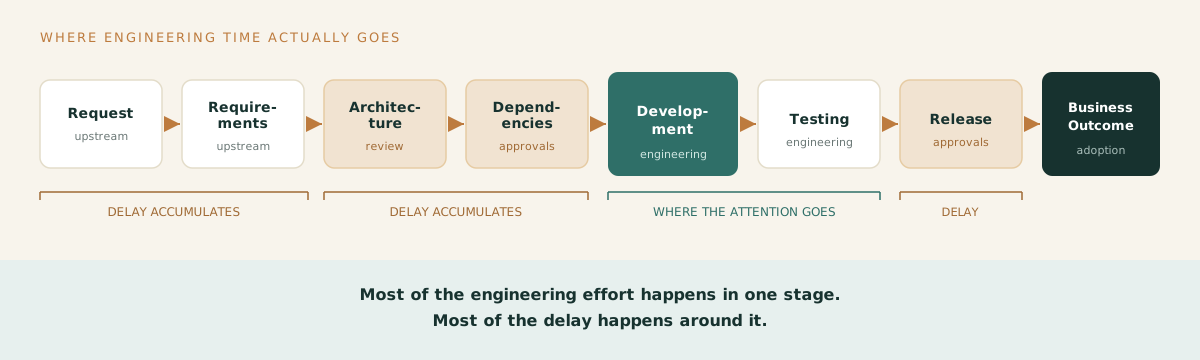
Most of the engineering effort happens in only one stage, yet the biggest delays occur before and after code is written. Organizations spend millions optimizing development while ignoring the larger bottlenecks wrapped around it.
This is also why many AI initiatives fail to deliver meaningful results. They focus on speeding up code generation while leaving decision systems, organizational bottlenecks, operational challenges, and the status quo untouched.
The Hidden Cost of Knowledge Latency
One of the least visible forms of enterprise friction is knowledge latency. Critical decisions are often scattered across architecture reviews, Architecture Decision Records (ADRs), meeting notes, email threads, collaboration platforms, and undocumented tribal knowledge. Some organizations invest heavily in documentation and governance, while others rely almost entirely on institutional memory. In both cases, information frequently becomes difficult to discover, validate, and operationalize over time.
The consequence is not simply poor documentation. Teams repeat analysis, revisit prior decisions, onboard more slowly, and spend valuable time searching for context instead of creating value. Before organizations can accelerate decisions, they must first accelerate access to trusted "tribal" knowledge.
Why Most Agentic AI Initiatives Will Fail
Agentic AI is quickly becoming the next enterprise priority, but many organizations are approaching it the wrong way. They treat agents as a more advanced coding assistant, and rapid proof-of-concepts only reinforce this misconception. Someone demos how fast an agent can generate code, middle managers get excited and rally around it, and suddenly the entire initiative is anchored to the wrong problem. The deeper issue is that many decision-makers don't fully understand the use cases of deterministic versus probabilistic systems, yet they're the ones shaping the strategy. Once an idea starts on the wrong note, the debt starts accumulating.
They measure things like lines of code generated, pull requests created, and "developer productivity." These metrics are easy to track but fundamentally insufficient. A few months ago, a senior engineer told me their new agents were generating so many commits that the CI/CD pipeline couldn't keep up.
In my view, the real value of agentic systems appears when they reduce organizational friction. The most successful implementations won't be the ones generating the most code — they'll be the ones accelerating architecture reviews, modernization assessments, technical due diligence, knowledge discovery, root cause analysis, cross-team coordination, and operational decision-making.
The key takeaway is simple: agentic AI isn't a software development tool. It's a decision-acceleration platform. If you don't understand where it should be applied, you're almost certainly not using it to its strength.
The Enterprise Maturity Model
Most organizations attempt to jump directly into advanced AI adoption without establishing the necessary core foundations. Most remain stuck at Level 1 while expecting Level 3 outcomes.
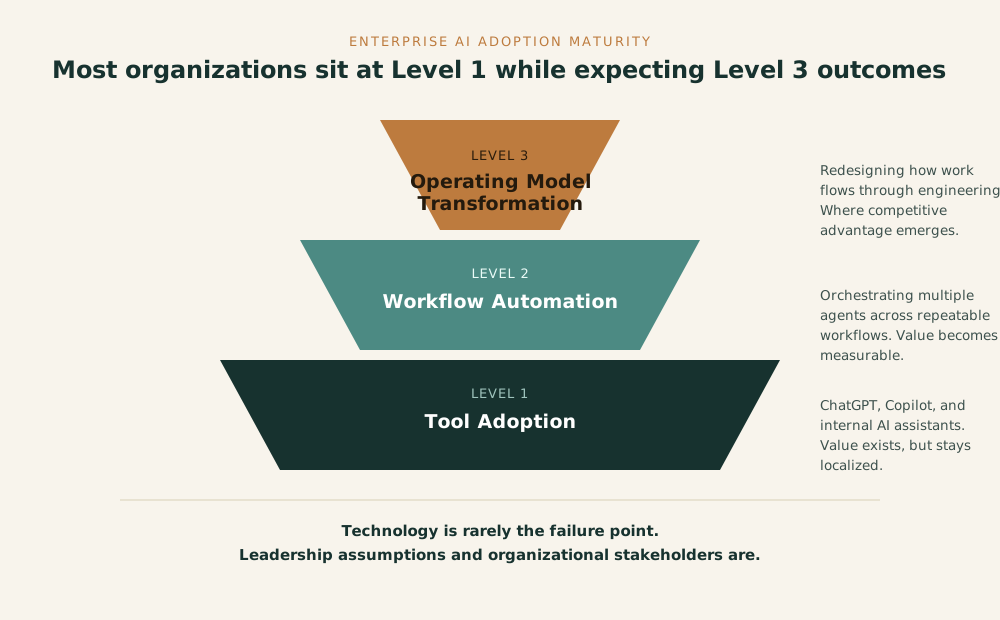
I see three stages of maturity.
Level 1: Tool Adoption
Organizations experiment with ChatGPT, Copilot, and internal AI assistants. Value exists, but it remains localized.
Level 2: Workflow Automation
Organizations begin orchestrating multiple agents across repeatable workflows — documentation generation, test creation, code reviews, architecture analysis, and knowledge retrieval. Value becomes measurable.
Level 3: Operating Model Transformation
This is where the real opportunity exists. Organizations redesign how work flows through engineering. Agentic systems become part of the delivery model itself. Decision-making becomes faster. Knowledge becomes more accessible. Modernization becomes more predictable. Engineering organizations become more scalable. This is where competitive advantage emerges.
What Engineering Leaders Get Wrong
Technology is rarely the primary failure point. Leadership assumptions and organizational stakeholders are. The most common pitfalls include:
Mistake #1: Starting With Tools
Leaders purchase platforms or increase AI adoption before identifying systemic bottlenecks or a holistic strategy. Technology should follow strategy, not the other way around.
Mistake #2: Ignoring Governance
Enterprise AI requires accountability, auditability, security, and clear escalation paths. Without governance, scale becomes risk.
Mistake #3: Automating Broken Processes
Many organizations attempt to automate inefficient workflows. This simply allows dysfunction to move faster.
Mistake #4: Measuring Activity Instead of Outcomes
The objective is not more AI activity. The objective is faster business outcomes. Measure cycle time, decision latency, lead time, modernization velocity, and cost reduction — not prompt counts.
To sum it up, there's a pattern I see constantly. A few months ago, I presented a strategic technology vision to a chief architect and senior architect, emphasizing AI as a force multiplier grounded in strong engineering and architectural fundamentals. Their response was, "Why do we need this? We're already seeing immediate gains." I wasn't surprised by the comment, but I was surprised that leaders with deep experience were falling into the same trap. This perception isn't limited to IT heads or directors; it exists at every level, and unfortunately, it flows straight down the org chart.
Why Private Equity Should Care
For private equity firms, the opportunity is even larger. Most portfolio companies struggle with technical debt, legacy platforms, integration complexity, engineering scalability, and knowledge concentration. These are not coding problems. They are decision problems.
Agentic systems can accelerate technical due diligence, architecture assessments, modernization planning, post-acquisition integration, and engineering productivity analysis. The firms that understand this distinction will create disproportionate value.
The conversation should not be "how much code can AI generate." The conversation should be "how much organizational friction can AI eliminate."
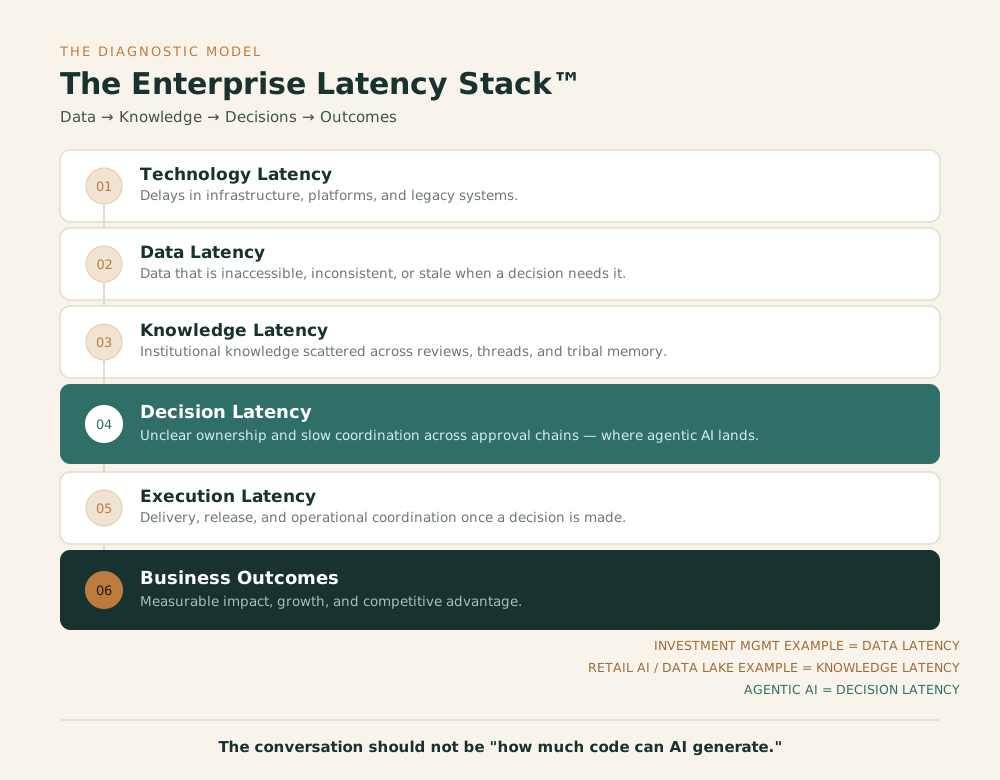
- Investment manager example = Data Latency
- Retail AI / Data Lake example = Knowledge Latency
- Support / Document Intelligence example = Knowledge Latency
- Agentic AI = Decision Latency
The Future Is Human-Agent Collaboration
The future is not autonomous software engineering. The future is rapid, augmented decision-making while human judgment remains essential. Architecture decisions remain essential. Business context and leadership remain essential.
What changes is the speed at which organizations can move from information to insight, and from insight to action — if we channel our energy on the right problem. The organizations that win over the next decade will not be those with the most sophisticated AI models. They will be those that redesign their operating models around faster decisions.
Because in large enterprises, the ultimate competitive advantage has never been writing code. It has always been reducing the time between knowing and acting.