Point of View
Agentic AI Exposes the Real Constraint: Enterprise Coordination, Not Technology
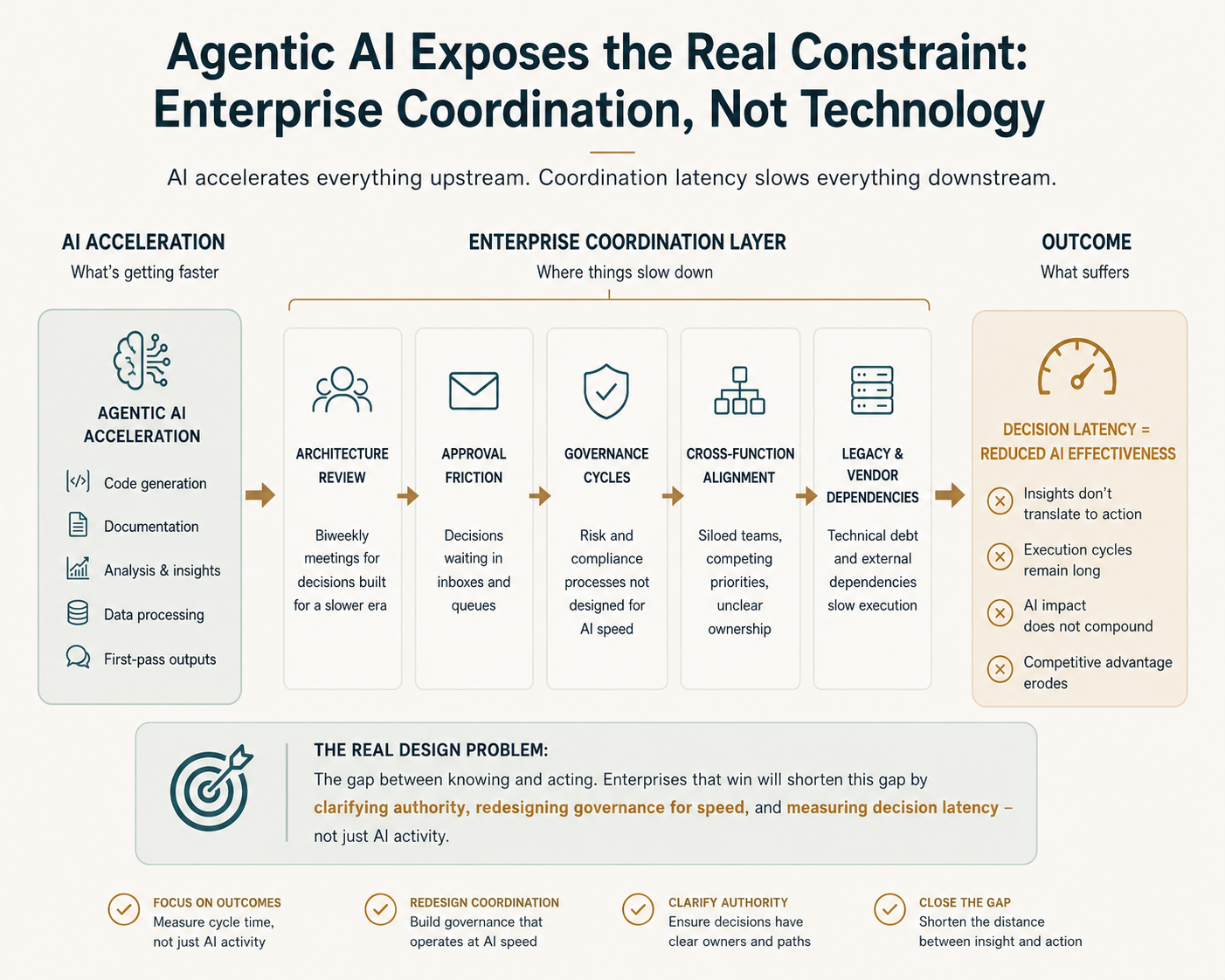
Most enterprises are about to discover their real constraint was never technology.
For years, "we need better tools" was a defensible excuse. Agentic AI just took it away. When an agent can draft, analyze, and generate in minutes, the question stops being "how fast can we build" and becomes "how fast can we decide." That second question is the one most enterprises can't answer well.
I've watched this play out inside a large investment platform where compliance and portfolio data moved across business units through batch-oriented pipelines. The technology wasn't the hard part. The hard part was that modernization competed against vendor lock-in, legacy risk, and a quiet institutional reluctance to touch anything that still technically worked. Latency became normal because the organization built itself around tolerating it.
Agentic AI doesn't fix that pattern. It reveals it. Speed up code generation, documentation, and first-pass analysis, and the bottleneck doesn't disappear. It just moves to the next boundary: the architecture review board that meets biweekly, the approval sitting in someone's inbox, the sign-off waiting on a governance cycle built for a slower era. One engineer told me their team's agents were producing commits faster than the CI/CD pipeline could absorb them. That's not a productivity win. That's the constraint relocating.
Deloitte's latest enterprise AI survey found that only about a third of organizations are actually redesigning core processes around AI. The rest are capturing productivity gains without touching the coordination structure underneath — and productivity gains without structural change rarely compound into lasting advantage.
McKinsey's research on executive decision-making tells a similar story: leaders report spending nearly 40 percent of their time on decisions, and by their own admission, most of that time is poorly used. Agentic AI accelerates everything upstream of that bottleneck and does nothing to remove it.
None of this is an argument against adoption. It's an argument for precision about what's actually being measured. Lines of code generated, agents deployed, and prompts run describe activity. Cycle time, decision latency, and lead time describe outcomes. Only one of those tells you whether the organization is actually getting faster.
The enterprises that pull ahead over the next decade won't be the ones with the most sophisticated models. They'll be the ones that treat decision latency as a design problem: clarifying who actually holds authority, building governance that can operate at the new cadence instead of just adding more of it, and measuring the distance between insight and action rather than the volume of AI activity.
Because the durable advantage in a large enterprise was never writing code faster. It has always been shortening the gap between knowing and acting.
Where is that gap widest in your organization right now — and who actually owns closing it?